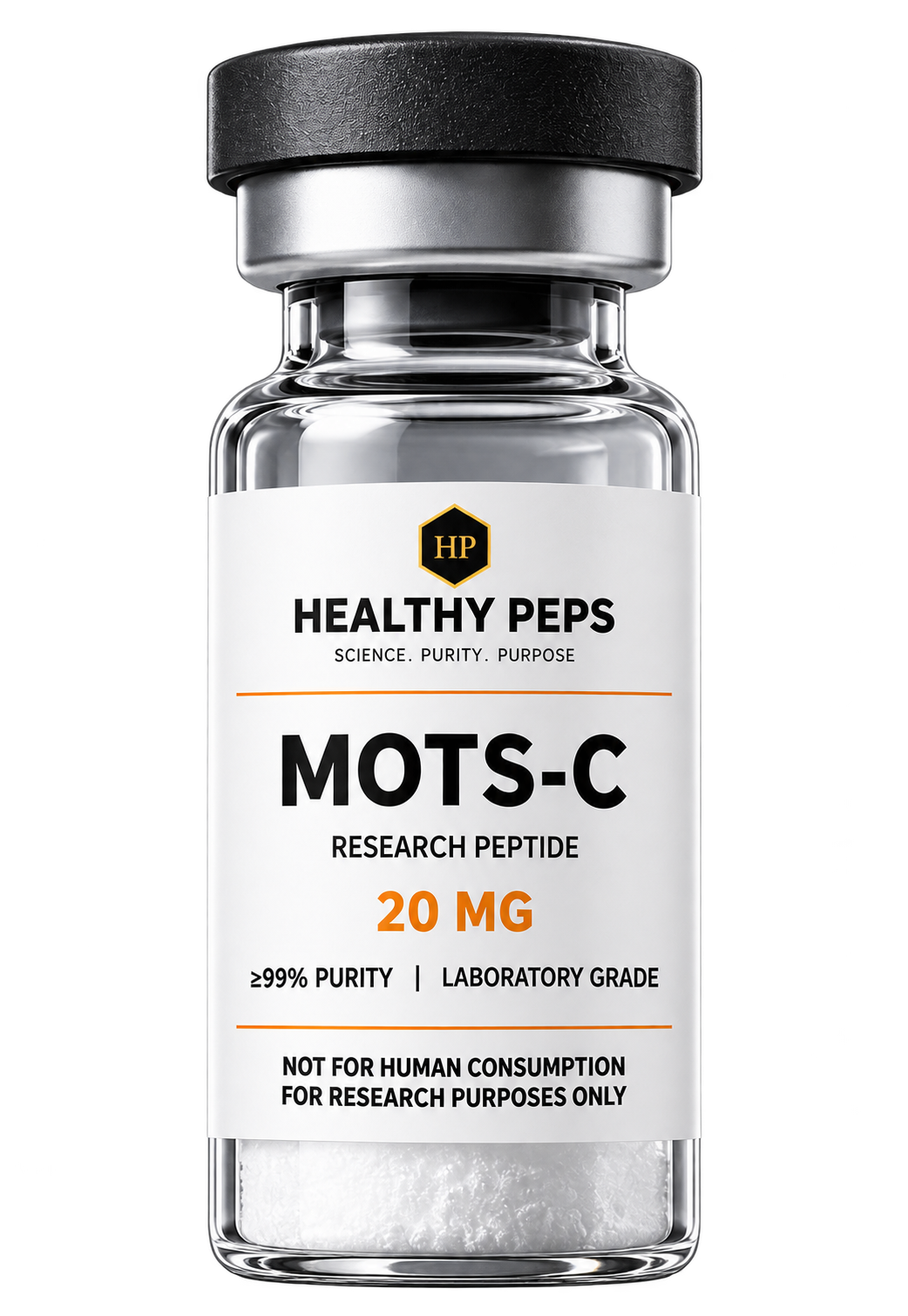
MOTS-C 20 mg is supplied by Healthy Peps as a lyophilized mitochondria-derived peptide for metabolic signalling research, shipped from Canada with batch documentation.
Healthy Peps Research Team · Research Editorial Team
Last reviewed November 2026. For in vitro laboratory research only.
Physicochemical Reference Data
| Compound | MOTS-c (mitochondrial open reading frame of the 12S rRNA-c) |
| CAS Number | 1627580-64-6 |
| Sequence | 16 amino acids — Met-Arg-Trp-Gln-Glu-Met-Gly-Tyr-Ile-Phe-Tyr-Pro-Arg-Lys-Leu-Arg |
| Reported Molecular Weight | ≈ 2,175 Da |
| Appearance | White lyophilized powder |
| Solubility (lab) | Water, saline, bacteriostatic water |
| Vial Format | 20 mg per vial |
| Storage | −20 °C lyophilized, protected from light |
Mechanism & Research Context
MOTS-c is a 16-amino-acid peptide encoded within the mitochondrial 12S rRNA region, placing it in the small but growing class of mitochondrially derived peptides. The foundational characterisation by Lee and colleagues in Cell Metabolism (2015) described it as a regulator of metabolic homeostasis acting through the AMPK pathway, with reported effects on glucose metabolism and stress-response signalling in cell and animal models.
Its research appeal is mechanistic: MOTS-c is one of the few peptides studied as a retrograde mitochondrial signal — a molecule produced by the mitochondrion that influences nuclear gene expression. That makes it a recurring subject in metabolic-adaptation research, including exercise-mimetic and insulin-sensitivity study designs.
In vitro, MOTS-c is used in AMPK-activation assays, mitochondrial stress and respiration models, and metabolic pathway screens in cultured cells. Because the sequence is short and well defined, analytical verification by HPLC and mass spectrometry is unambiguous, and batch documentation reports a single-peak purity result.
The 20 mg format suits laboratories running repeated metabolic assays from a single documented batch.
How It Compares to Related Peptides
MOTS-c is not a receptor agonist in the incretin or GH-axis families. Its research mechanism — AMPK-pathway activation downstream of a mitochondrial signal — gives it a distinct place in metabolic study designs, which is why it is normally run as its own experimental arm rather than as a substitute for other peptides on this catalogue.
Reconstitution, Stability & Handling
Reconstitute in bacteriostatic water or the diluent specified by your protocol, adding it slowly against the vial wall and swirling gently. Avoid vortexing, which can shear peptide chains. Keep reconstituted solutions refrigerated and within your protocol window; store lyophilized vials at −20 °C protected from light.
Selected Reading & Research Notes
- Lee et al. (2015): The mitochondrial-derived peptide MOTS-c. Primary experimental research on metabolic signaling in preclinical models. Findings do not establish human use or validate a supplied batch.
Frequently Asked Questions
Where can I buy MOTS-C in Canada?
From Healthy Peps, shipped from within Canada with tracking and batch-specific documentation.
What is a mitochondria-derived peptide?
It is a peptide encoded within mitochondrial DNA rather than nuclear DNA; MOTS-c is studied as a retrograde signal from the mitochondrion.
Is a COA included?
Check the Lab Results page for a published report matching the compound, package size and current lot. If no report is linked, contact info@healthypeps.co before ordering. A report for another lot is not evidence for your material.
Is MOTS-C intended for human use?
No. It is supplied for laboratory research only and is not intended for human or veterinary consumption.
What size vial is supplied?
20 mg of lyophilized peptide per sealed vial.
Ready to order MOTS-C 20 mg?
View product & batch documentation