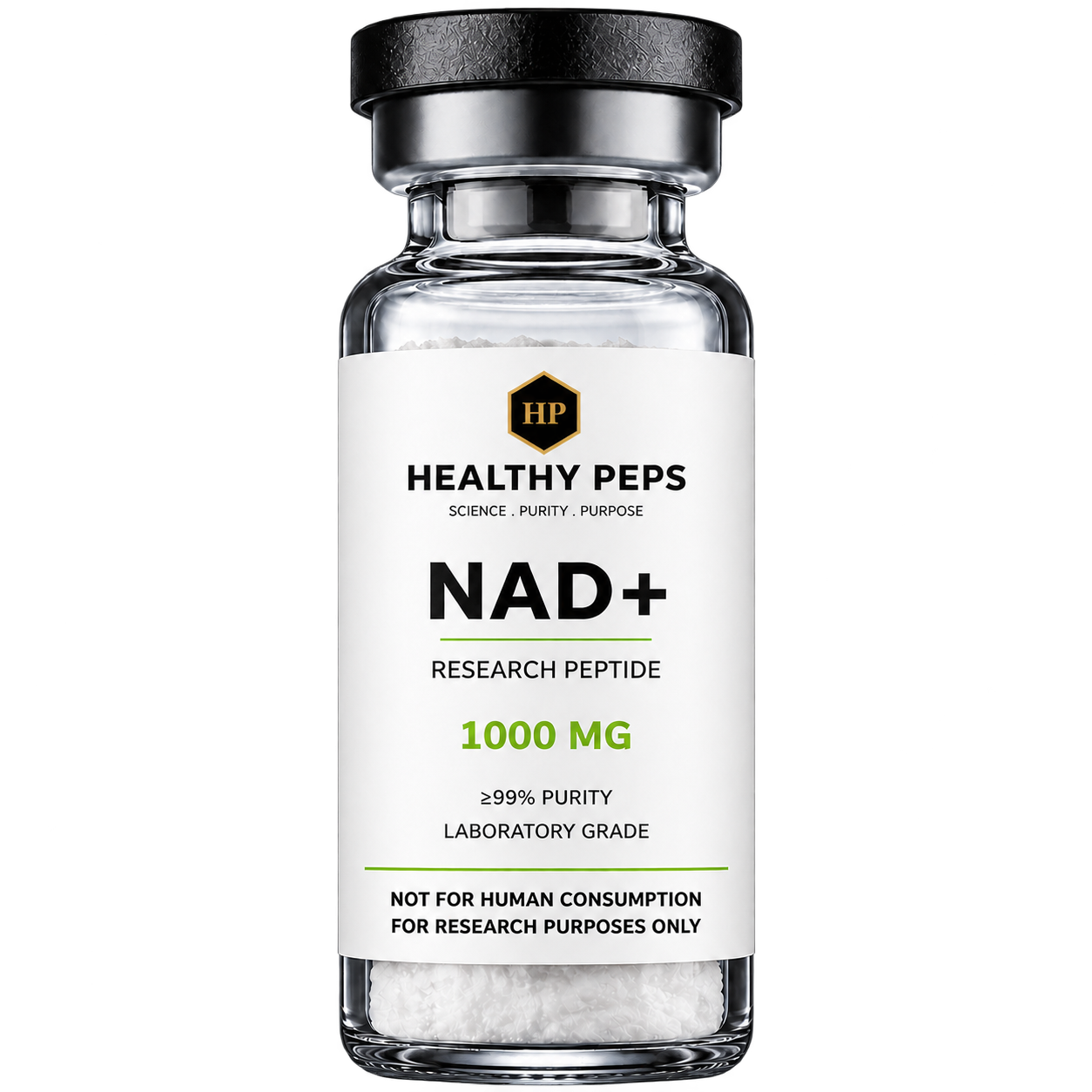
NAD+ 1000 mg is supplied by Healthy Peps as a high-purity nicotinamide adenine dinucleotide preparation for in vitro redox and enzymology research, shipped from Canada with batch documentation.
Healthy Peps Research Team · Research Editorial Team
Last reviewed November 2026. For in vitro laboratory research only.
Physicochemical Reference Data
| Compound | β-Nicotinamide adenine dinucleotide, free acid |
| CAS Number | 53-84-9 |
| Molecular Formula | C21H27N7O14P2 |
| Molecular Weight | 663.43 g/mol |
| Appearance | White to off-white powder |
| Solubility (lab) | Highly soluble in water; buffer-compatible |
| Vial Format | 1000 mg per vial |
| Storage | −20 °C, desiccated, protected from light |
Mechanism & Research Context
NAD+ is the central redox coenzyme of cellular metabolism, cycling between oxidised NAD+ and reduced NADH in glycolysis, the TCA cycle and oxidative phosphorylation. In the research literature it is also the substrate for two enzyme families of intense interest: the sirtuins and the PARPs, both of which consume NAD+ as part of their catalytic cycle.
That second role is why NAD+ appears so often in ageing and metabolic research: published work describes declining tissue NAD+ with age and examines whether restoring NAD+ availability alters sirtuin activity, mitochondrial function or DNA-repair signalling in cell and animal models. Enzyme-kinetics studies use defined NAD+ concentrations as the rate-limiting substrate for dehydrogenase assays, which is why a precise, documented quantity matters more here than in almost any other catalogue item.
The 1000 mg format suits laboratories that prepare their own working stocks and need a substantial, single-batch quantity rather than many small vials. Assay designers typically prepare fresh NAD+ solutions because the coenzyme hydrolyses slowly in aqueous solution, particularly at neutral or alkaline pH.
Healthy Peps supplies NAD+ as a free-acid powder with a documented purity result and batch number.
How It Compares to Related Peptides
Unlike the peptide vials on this catalogue, NAD+ is a small-molecule coenzyme: it is water-soluble at high concentration, is not reconstituted from lyophilized cake, and is used as an assay substrate rather than a receptor ligand. It also pairs with NADH precursor research compounds in metabolic studies.
Reconstitution, Stability & Handling
Prepare working solutions fresh in water or the buffer specified by your assay. NAD+ hydrolyses in aqueous solution, so solutions should be kept cold and used promptly rather than stored for extended periods. The bulk powder should be kept desiccated at −20 °C, protected from light, and allowed to equilibrate to room temperature before opening to avoid condensation.
Selected Reading & Research Notes
- NAD+ and sirtuin biology literature. Reviews describing NAD+ as the rate-limiting substrate for sirtuin deacetylation and its decline with age in tissue models.
- NAD+ / PARP enzymology. Establishes NAD+ consumption by poly(ADP-ribose) polymerases during DNA-damage response assays.
Frequently Asked Questions
Where can I buy NAD+ in Canada?
Healthy Peps ships NAD+ 1000 mg Canada-wide from within Canada, with batch documentation included.
What purity is the NAD+ supplied at?
Consult a published report matching the lot for analytical results. Catalogue specifications alone do not establish the result for a particular batch.
Is NAD+ suitable for human consumption?
No. It is supplied strictly as a laboratory research reagent and is not intended for human or veterinary use.
How should NAD+ be stored?
Keep the sealed powder desiccated at −20 °C, protected from light. Prepare working solutions fresh, as aqueous NAD+ hydrolyses over time.
Why is the 1000 mg format preferable?
A single large, documented batch lets a laboratory prepare many working stocks with consistent purity, instead of re-verifying numerous small vials.
Ready to order NAD+ 1000 mg?
View product & batch documentation