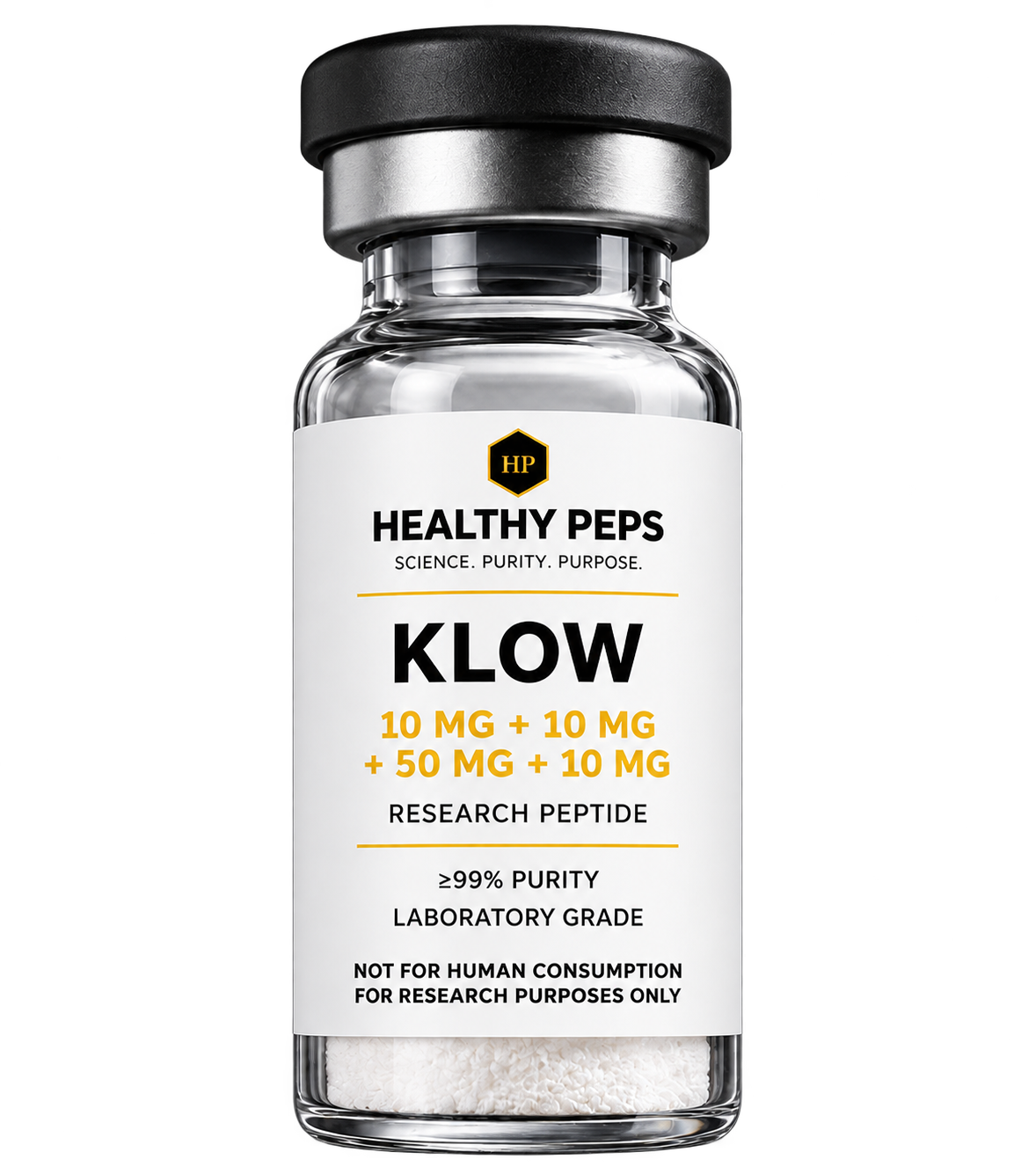
KLOW Blend is supplied by Healthy Peps as a single lyophilized multi-compound research vial, shipped from Canada with the component composition and batch documentation recorded on the product COA.
Healthy Peps Research Team · Research Editorial Team
Last reviewed November 2026. For in vitro laboratory research only.
Physicochemical Reference Data
| Format | Four-component blended research formulation |
| Composition | GHK-Cu 50 mg · BPC-157 10 mg · TB-500 10 mg · KPV 10 mg |
| Total Mass | 80 mg per vial |
| GHK-Cu (share) | 50 mg (62.5% of blend) — copper-binding tripeptide, collagen and ECM signaling |
| BPC-157 (share) | 10 mg (12.5% of blend) — pentadecapeptide, repair and angiogenesis research |
| TB-500 (share) | 10 mg (12.5% of blend) — thymosin beta-4 fragment, cell migration and remodeling |
| KPV (share) | 10 mg (12.5% of blend) — alpha-MSH C-terminal tripeptide, inflammatory signaling |
| Appearance | White to off-white lyophilized powder |
| Solubility (lab) | Water, saline, bacteriostatic water |
| Composition Record | Printed on the batch label and Certificate of Analysis |
| Storage | −20 °C lyophilized, protected from light |
Mechanism & Research Context
KLOW Blend is a co-formulated research vial containing four peptides — GHK-Cu (50 mg), BPC-157 (10 mg), TB-500 (10 mg), and KPV (10 mg) — lyophilized together into one sealed 80 mg vial rather than supplied separately. The research rationale for blended formats is consistency: co-formulation fixes the ratio between components into a single batch record, so an experimental series that compares treatment conditions starts from an identical material composition every time.
Multi-compound vials also simplify protocol logistics. A study that would otherwise require preparing and documenting three or four separate stock solutions from separate vials, each with its own reconstitution step and batch record, instead works from one documented batch and one reconstitution. That reduces the surface area for preparation error, which is one of the more common sources of unexplained variance in cell-based work.
Because blended products cannot be verified by the same single-peak HPLC method used for a pure compound, documentation quality matters more here than anywhere else on the catalogue: the batch record is what establishes what is in the vial and in what proportion. Healthy Peps prints the component composition and total mass on the batch label, and the corresponding COA is published on the Lab Results page.
KLOW Blend is intended for laboratory research into co-formulated peptide systems and for comparative in vitro work where a fixed multi-component composition is required.
How It Compares to Related Peptides
KLOW Blend differs from every other item on this catalogue in that it is a fixed multi-component composition rather than a single verified compound. If your protocol needs to vary the ratio between components, or requires single-peak HPLC verification of one compound, order the individual compounds instead.
Reconstitution, Stability & Handling
Reconstitute with the diluent specified by your protocol, adding it slowly against the vial wall and swirling gently; blended lyophilized cakes can take longer to dissolve completely than single-component vials. Do not vortex. Confirm the solution is clear and free of undissolved material before use, and follow your protocol’s storage window for reconstituted material.
Selected Reading & Research Notes
- Co-formulation and peptide stability literature. Describes how lyophilized co-formulated protein and peptide systems are characterised when single-component HPLC verification is not applicable.
- Batch documentation guidance for research reagents. The rationale for batch-specific documentation as the basis for reproducible experimental material.
Frequently Asked Questions
What is in the KLOW Blend vial?
Each 80 mg vial contains GHK-Cu (50 mg), BPC-157 (10 mg), TB-500 (10 mg), and KPV (10 mg) — the GLOW stack (GHK-Cu, BPC-157, TB-500) with KPV added. The full component composition and total mass are printed on the batch label and recorded on the Certificate of Analysis available on the Lab Results page.
Why is GHK-Cu dosed higher than the other components?
GHK-Cu makes up 62.5% of the blend because it is the largest molecule and serves as the primary tissue-repair and collagen-signaling component. The other three peptides are active at smaller masses.
Why are compounds supplied blended instead of separately?
Co-formulation fixes the ratio between components into a single documented batch, which improves consistency and reduces preparation steps in comparative research protocols.
Where can I buy KLOW Blend in Canada?
Healthy Peps ships KLOW Blend Canada-wide from within Canada, with batch documentation included.
Is a Certificate of Analysis available?
Check the Lab Results page for a published report matching the compound, package size and current lot. If no report is linked, contact info@healthypeps.co before ordering. A report for another lot is not evidence for your material.
Is KLOW Blend for human use?
No. It is supplied strictly for laboratory research and is not intended for human or veterinary consumption.
Ready to order KLOW Blend?
View product & batch documentation