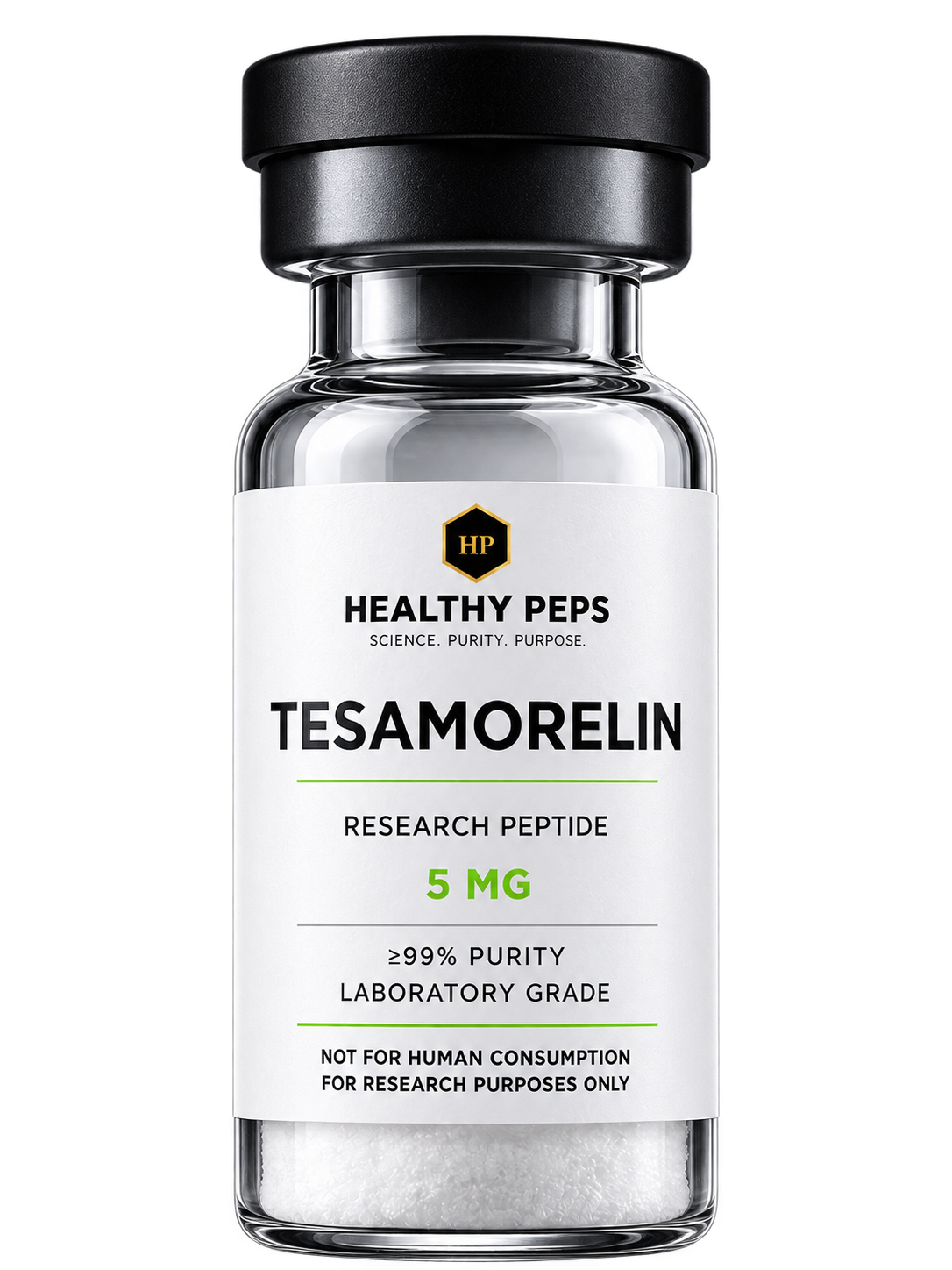
Tesamorelin 5 mg is supplied by Healthy Peps as a lyophilized GRF analog for GHRH-receptor research, shipped from Canada with batch documentation and an available COA.
Healthy Peps Research Team · Research Editorial Team
Last reviewed November 2026. For in vitro laboratory research only.
Physicochemical Reference Data
| Compound | Tesamorelin (GRF(1-44) analog with trans-3-hexenoyl modification at Tyr1) |
| CAS Number | 218949-48-5 |
| Peptide Length | 44 amino acids |
| Reported Molecular Weight | ≈ 5,136 Da (as acetate) |
| Appearance | White lyophilized powder |
| Solubility (lab) | Water, saline, bacteriostatic water |
| Vial Format | 5 mg per vial |
| Storage | −20 °C lyophilized, protected from light |
Mechanism & Research Context
Tesamorelin is a stabilised analog of growth-hormone-releasing factor, GRF(1-44), carrying a trans-3-hexenoyl group at the N-terminal tyrosine. The modification slows cleavage by dipeptidyl peptidase IV and is reported to increase potency relative to the unmodified GRF sequence, which is why it became the most extensively characterised long GRF analog in the clinical literature.
It is also the best-documented GRF analog in peer-reviewed medicine: the phase 3 work by Falutz and colleagues, published in the New England Journal of Medicine (2007), examined visceral adipose tissue endpoints in HIV-associated lipodystrophy, and the compound later received regulatory approval for that indication. For laboratory researchers, that body of published data is often used as the reference standard when comparing shorter GRF analogs such as the mod GRF(1-29) sequence.
In vitro, tesamorelin is used in GHRH-receptor binding and cAMP assays, pituitary cell-culture release studies, and structure-activity comparisons across the GRF analog family. Its 44-residue length makes it a useful contrast case against the 29-residue analogs when studying how chain length and terminal modifications affect receptor kinetics.
The 5 mg vial reflects the fact that the long GRF sequence is typically used at lower molar quantities per assay than shorter analogs.
How It Compares to Related Peptides
Tesamorelin targets the same GHRH receptor as CJC-1295 No DAC, but it is the longer, more extensively documented analog with a different modification strategy. Protocols comparing chain length or DPP-IV resistance across GRF analogs use both; protocols optimising for a short washout window use the mod GRF(1-29) sequence instead.
Reconstitution, Stability & Handling
Reconstitute with bacteriostatic water, adding the diluent against the vial wall and swirling gently rather than vortexing. Reconstituted material should be refrigerated and used within the window defined by your protocol. Keep lyophilized vials at −20 °C, protected from light and moisture.
Selected Reading & Research Notes
- Falutz J, et al. — New England Journal of Medicine (2007). Phase 3 study of tesamorelin examining visceral adipose tissue endpoints in HIV-associated lipodystrophy.
- GRF analog structure-activity literature. Describes the trans-3-hexenoyl N-terminal modification and its effect on DPP-IV resistance and potency.
Frequently Asked Questions
Where can I buy tesamorelin in Canada?
From Healthy Peps — shipped Canada-wide from within Canada with batch documentation and a downloadable COA.
How does tesamorelin differ from CJC-1295 No DAC?
Both act at the GHRH receptor, but tesamorelin is the 44-amino-acid GRF analog with an N-terminal trans-3-hexenoyl modification, while CJC-1295 No DAC is the shorter 29-residue tetrasubstituted analog.
Is a batch-specific Certificate of Analysis available?
Check the Lab Results page for a published report matching the compound, package size and current lot. If no report is linked, contact info@healthypeps.co before ordering. A report for another lot is not evidence for your material.
Is tesamorelin for human consumption?
No. It is supplied strictly for laboratory research use and is not intended for human or veterinary consumption.
Why is it supplied in a 5 mg vial?
The long GRF sequence is typically used at lower molar quantities per assay, so 5 mg is the practical working size.
Ready to order Tesamorelin 5 mg?
View product & batch documentation