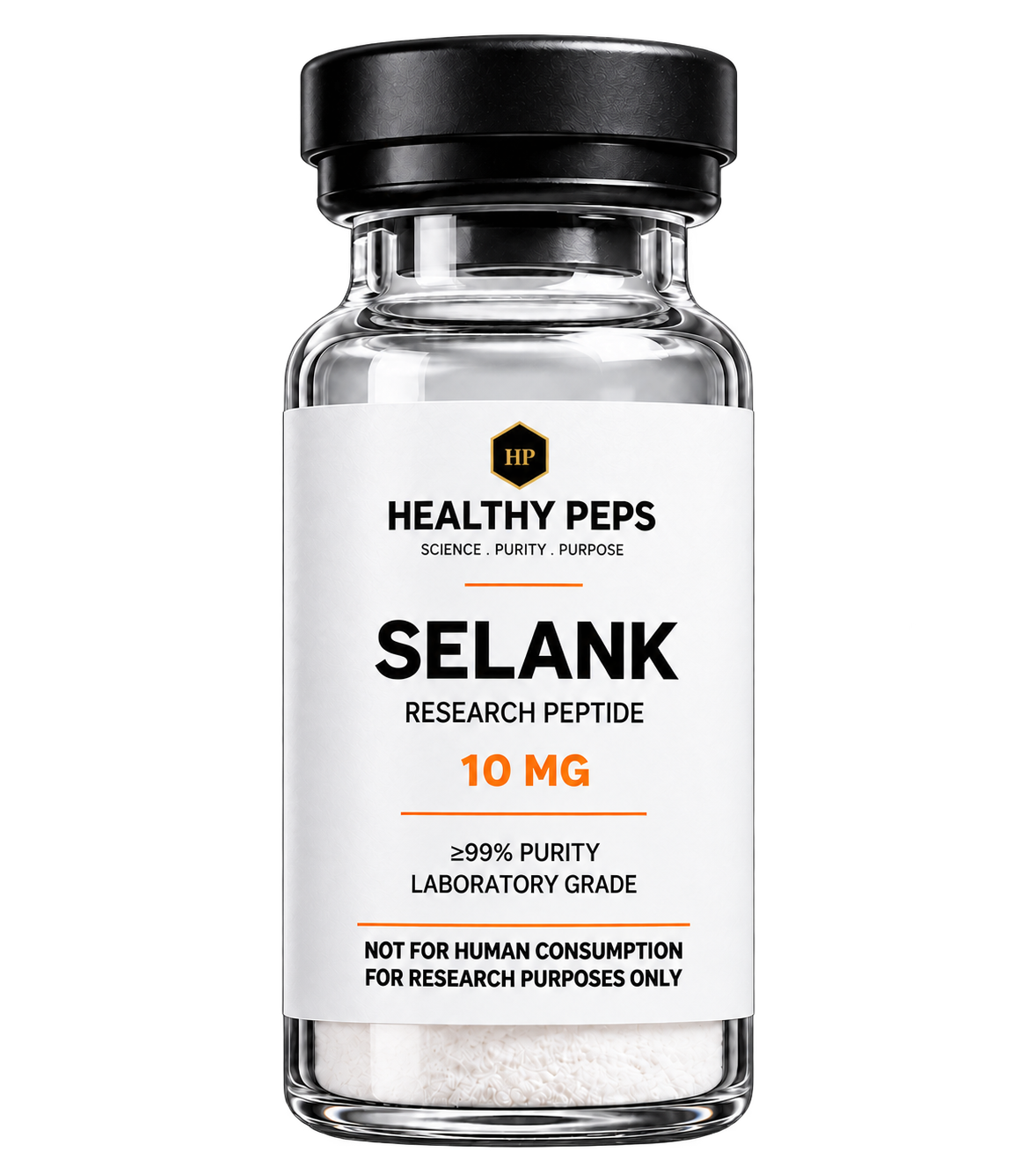
Selank 10 mg is supplied by Healthy Peps as a lyophilized synthetic neuropeptide for in vitro neuropeptide and GABAergic signalling research, shipped from Canada with batch documentation.
Healthy Peps Research Team · Research Editorial Team
Last reviewed November 2026. For in vitro laboratory research only.
Physicochemical Reference Data
| Compound | Selank (tuftsin analog, TP-7) |
| CAS Number | 129954-34-3 |
| Sequence | Thr-Lys-Pro-Arg-Pro-Gly-Pro |
| Molecular Weight | ≈ 751.9 Da |
| Appearance | White lyophilized powder |
| Solubility (lab) | Water, saline, bacteriostatic water |
| Vial Format | 10 mg per vial |
| Storage | −20 °C lyophilized, protected from light |
Mechanism & Research Context
Selank is a synthetic heptapeptide derived from the immunomodulatory tetrapeptide tuftsin, extended with a Pro-Gly-Pro sequence that improves resistance to enzymatic degradation. It was developed in the same Russian research programme that produced Semax, and the two are frequently discussed together as short synthetic neuropeptides with stabilising C-terminal extensions.
The published research literature on selank centres on anxiolytic-like and cognitive endpoints in animal models, with reported involvement of GABAergic and monoaminergic signalling and effects on BDNF expression in brain tissue. Independent replication outside the original research groups is limited compared with more widely studied compounds, and Healthy Peps presents these findings as literature-reported rather than established.
In laboratory work, selank is used in neuropeptide signalling assays, neuronal and glial culture studies, and comparative work on tuftsin-derived sequences. Its short, defined chain makes analytical verification unambiguous.
The 10 mg vial is the standard working quantity for in vitro protocols and matches the batch number on the corresponding COA.
How It Compares to Related Peptides
Selank and Semax are both short stabilised neuropeptides, but they derive from different parent sequences — tuftsin and ACTH(4-10) respectively — and are studied against different endpoints. They are complementary in a neuropeptide research programme, not interchangeable.
Reconstitution, Stability & Handling
Reconstitute with bacteriostatic water or the diluent specified by your protocol, adding it slowly against the vial wall and swirling gently. Do not vortex. Refrigerate reconstituted solution and use within your protocol window; store lyophilized vials at −20 °C, protected from light.
Selected Reading & Research Notes
- Russian selank neuropeptide literature. Reports anxiolytic-like and cognitive endpoints in animal models, with GABAergic, monoaminergic and BDNF-related findings.
- Tuftsin analog research. Describes the Pro-Gly-Pro modification strategy for peptidase resistance in short synthetic neuropeptides.
Frequently Asked Questions
Where can I buy selank in Canada?
From Healthy Peps, shipped Canada-wide from within Canada with tracking and batch documentation.
How does selank differ from Semax?
Both are short synthetic neuropeptides with Pro-Gly-Pro extensions, but selank derives from tuftsin while Semax derives from ACTH(4-10).
Is a Certificate of Analysis included?
Check the Lab Results page for a published report matching the compound, package size and current lot. If no report is linked, contact info@healthypeps.co before ordering. A report for another lot is not evidence for your material.
Is selank for human consumption?
No. It is supplied for laboratory research only and is not intended for human or veterinary consumption.
What vial size is supplied?
10 mg of lyophilized peptide per sealed vial.
Ready to order Selank 10 mg?
View product & batch documentation