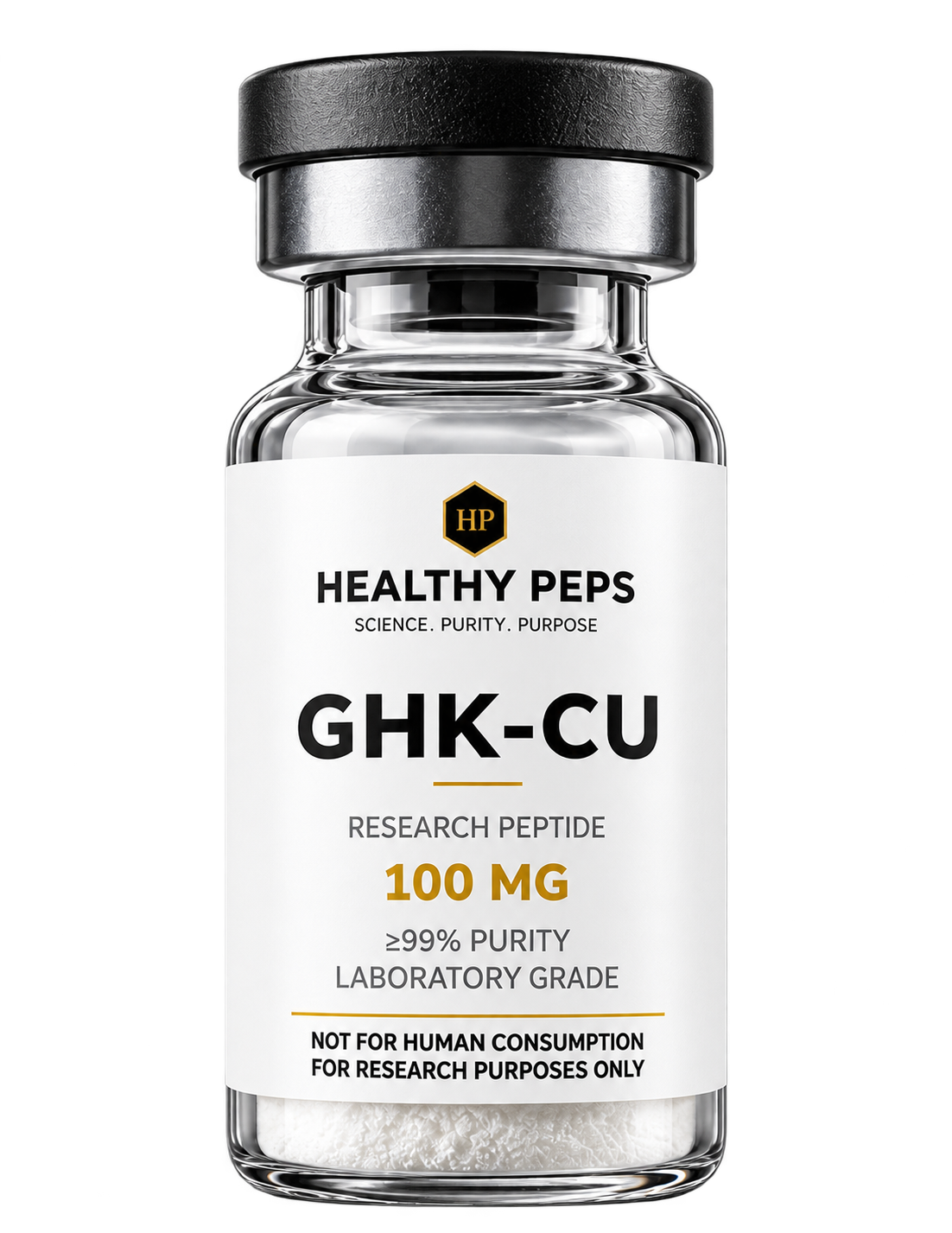
GHK-Cu 100 mg is supplied by Healthy Peps as a lyophilized copper tripeptide complex for in vitro matrix-remodelling and collagen research, shipped from Canada with batch documentation.
Healthy Peps Research Team · Research Editorial Team
Last reviewed November 2026. For in vitro laboratory research only.
Physicochemical Reference Data
| Compound | GHK-Cu (glycyl-L-histidyl-L-lysine : copper(II)) |
| CAS Number | 89030-95-5 |
| Molecular Formula | C14H22CuN6O4 |
| Molecular Weight | ≈ 402.9 g/mol |
| Appearance | Deep blue lyophilized powder (copper complex) |
| Solubility (lab) | Water, saline, buffer systems |
| Vial Format | 100 mg per vial |
| Storage | −20 °C lyophilized, protected from light |
Mechanism & Research Context
GHK-Cu is a naturally occurring tripeptide (glycine-histidine-lysine) bound to a copper(II) ion. The copper complex is the research-relevant form: published work by Pickart and colleagues describes GHK-Cu as a modulator of gene expression in fibroblast and keratinocyte culture, with reported effects on collagen synthesis, matrix metalloproteinase activity and antioxidant response in cell models, and later reviews extend that to broader regenerative and protective signalling.
The distinctive deep blue colour of the lyophilized powder is a practical advantage in the laboratory: the copper complex is visible, so dissolution and concentration checks are straightforward compared with colourless peptides. The 100 mg format supports extended cell-culture and biochemical series without opening multiple vials.
In published in vitro research, GHK-Cu is used to study dermal matrix biology, wound-healing model systems, copper-dependent enzyme activity and gene-expression changes in cultured fibroblasts. It is also used as a copper-delivery comparator in trace-metal research designs.
Because the copper complex is sensitive to chelating agents and reducing conditions, protocols typically avoid EDTA-containing buffers and strongly reducing environments.
How It Compares to Related Peptides
GHK-Cu is the only metal-peptide complex on this catalogue. Unlike the receptor-ligand peptides here, its research activity is studied through gene-expression and matrix-remodelling endpoints rather than receptor binding, and its handling requirements around chelators are unique to it.
Reconstitution, Stability & Handling
Reconstitute in water or a non-chelating buffer and swirl gently to dissolve. The solution should be a clear blue; a colourless solution, or precipitation, indicates the complex has been disrupted. Avoid EDTA and strongly reducing buffers. Store lyophilized at −20 °C protected from light, and keep reconstituted material refrigerated.
Selected Reading & Research Notes
- Pickart L & Margolina A — International Journal of Molecular Sciences (2018). Review of GHK-Cu regenerative and protective actions in the light of gene-expression data.
- Pickart L, et al. — fibroblast culture studies. Reported collagen synthesis and matrix-metalloproteinase modulation by GHK-Cu in cell models.
Frequently Asked Questions
Where can I buy GHK-Cu 100 mg in Canada?
Directly from Healthy Peps — shipped from within Canada with tracking, batch documentation and a downloadable COA.
Why is the powder blue?
The blue colour comes from the copper(II) ion complexed to the tripeptide. Clear blue solution after reconstitution is the expected appearance.
What buffers should be avoided with GHK-Cu?
Chelating agents such as EDTA and strongly reducing conditions can strip or alter the copper complex, so non-chelating buffers are used instead.
Is GHK-Cu for human consumption?
No. It is supplied strictly for laboratory and in vitro research use and is not intended for human or veterinary consumption.
Is the 100 mg size a single batch?
Yes — the full 100 mg comes from one documented batch with a single purity result.
Ready to order GHK-Cu 100 mg?
View product & batch documentation