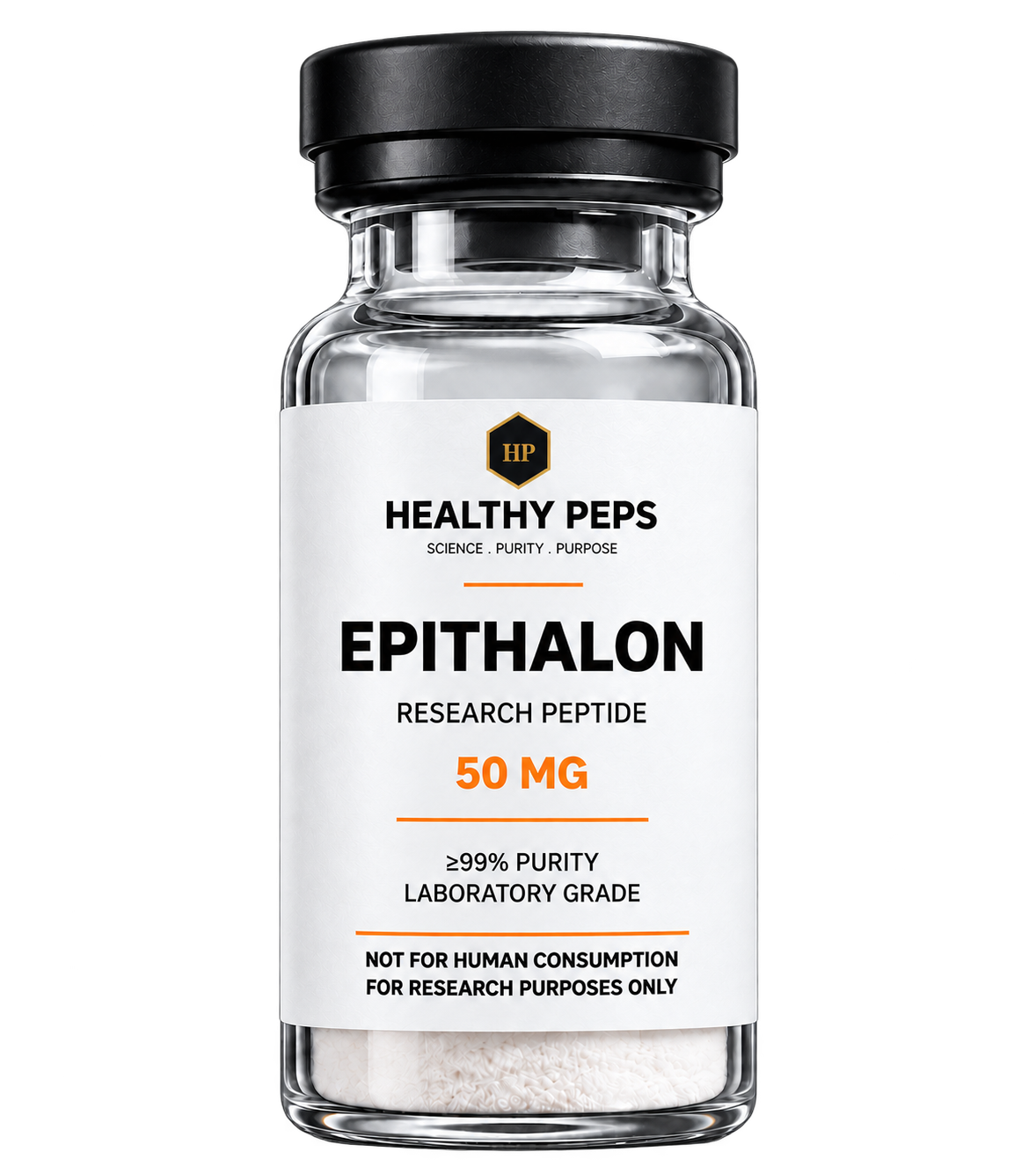
Epithalon 50 mg (epitalon, AEDG) is supplied by Healthy Peps as a lyophilized tetrapeptide for telomerase and cellular-ageing research, shipped from Canada with batch documentation.
Healthy Peps Research Team · Research Editorial Team
Last reviewed November 2026. For in vitro laboratory research only.
Physicochemical Reference Data
| Compound | Epithalon / Epitalon (Ala-Glu-Asp-Gly) |
| CAS Number | 307297-39-8 |
| Sequence | Ala-Glu-Asp-Gly (AEDG) |
| Molecular Weight | ≈ 390.35 Da |
| Appearance | White lyophilized powder |
| Solubility (lab) | Water, saline, bacteriostatic water |
| Vial Format | 50 mg per vial |
| Storage | −20 °C lyophilized, protected from light |
Mechanism & Research Context
Epithalon is a synthetic tetrapeptide derived from the bovine pineal extract epithalamin. Its research profile rests mainly on work by Khavinson and colleagues reporting that the AEDG sequence induced telomerase activity in cultured human somatic cells, published in the Bulletin of Experimental Biology and Medicine in the early 2000s. That finding is the reason epithalon appears in nearly every review of peptide-based telomere research.
Telomerase activation in somatic cells is an unusual property and a correspondingly sensitive research area, so the published literature should be read carefully and critically: replication of the original findings in independent model systems remains the subject of ongoing work. Healthy Peps lists the compound for replicate-study purposes, not as an established result.
In the laboratory, epithalon is used in cell-culture ageing models, telomerase activity assays, and studies of chromatin and gene-expression changes over successive cell passages. Its short, defined sequence makes HPLC and mass-spectrometric verification straightforward.
The 50 mg format supports long-duration cell-culture protocols, which typically consume more material than acute assays.
How It Compares to Related Peptides
Epithalon’s research endpoint — telomerase activity and replicative lifespan in cultured cells — is distinct from every other peptide on this catalogue. It is studied in ageing and senescence models, so it is not a functional alternative to metabolic, GH-axis or neuropeptide research compounds.
Reconstitution, Stability & Handling
Reconstitute with bacteriostatic water or your protocol diluent, adding it against the vial wall and swirling gently; avoid vortexing. Store reconstituted material refrigerated and use within your protocol window. Lyophilized vials are held at −20 °C, protected from light and moisture.
Selected Reading & Research Notes
- Khavinson VKh, et al. — Bulletin of Experimental Biology and Medicine (early 2000s). Reported telomerase activation in cultured human somatic cells by the AEDG peptide.
- Peptide-based telomere research reviews. Discuss replication and criticism of telomerase-induction findings in independent model systems.
Frequently Asked Questions
Where can I buy epithalon in Canada?
From Healthy Peps — shipped from within Canada with tracking, batch documentation and a downloadable COA.
What is the sequence of epithalon?
Ala-Glu-Asp-Gly (AEDG), supplied as a lyophilized tetrapeptide.
What is epithalon studied for?
Published work by Khavinson and colleagues reported telomerase induction in cultured somatic cells; it is used in cell-ageing and senescence research models.
Is epithalon intended for human consumption?
No. It is supplied strictly for laboratory research and is not intended for human or veterinary use.
Is a COA available?
Check the Lab Results page for a published report matching the compound, package size and current lot. If no report is linked, contact info@healthypeps.co before ordering. A report for another lot is not evidence for your material.
Ready to order Epithalon 50 mg?
View product & batch documentation