Understanding Retatrutide in Modern Metabolic Research
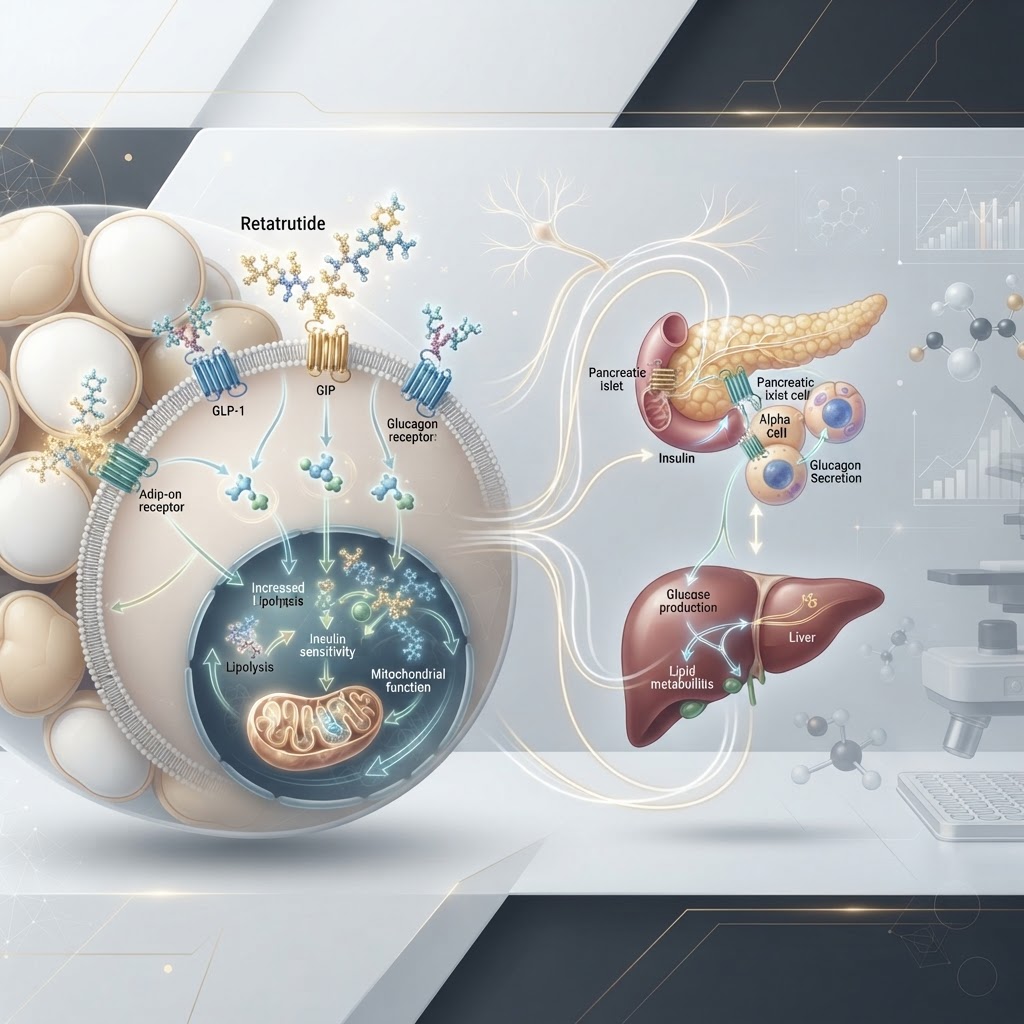
The landscape of metabolic science has shifted significantly with the emergence of multi-receptor agonists. Among these, retatrutide has become a focal point for investigators exploring complex metabolic pathways. As a unimolecular triple agonist targeting the glucagon-like peptide-1 (GLP-1), glucose-dependent insulinotropic polypeptide (GIP), and glucagon (GCG) receptors, retatrutide offers a unique opportunity to study the synergistic effects of these pathways in controlled laboratory settings.
At Healthy Peps, we support the Canadian scientific community by providing high-purity retatrutide for in vitro laboratory research. It is important to note that all products supplied are for in vitro laboratory research only and are not intended for human consumption.
The Mechanism of Triple Agonism
Retatrutide’s structural design allows it to interact with three distinct receptors, each playing a critical role in metabolic homeostasis. By integrating these activities into a single molecule, researchers can observe how simultaneous receptor activation influences cellular signaling compared to single or dual-agonist models.
- GLP-1 Receptor Agonism: Primarily associated with the modulation of insulin secretion and appetite-related signaling pathways.
- GIP Receptor Agonism: Known to enhance the metabolic benefits of GLP-1 while potentially mitigating certain side effects observed in isolated GLP-1 studies.
- Glucagon Receptor Agonism: A key differentiator for retatrutide, which is hypothesized to increase energy expenditure, a factor of significant interest in metabolic pathway studies.
Structural studies, such as those utilizing cryo-EM, have provided insights into how retatrutide adopts a continuous helix to penetrate the transmembrane domains of these receptors, facilitating balanced activation.
Retatrutide Research in Metabolic Models
Recent investigations have utilized various animal models to characterize the efficacy of retatrutide. In diet-induced obese (DIO) mouse and hamster models, researchers have observed significant improvements in metabolic parameters. For instance, studies have demonstrated that retatrutide can lead to a substantial reduction in hepatic triglyceride content, highlighting its potential utility in studying metabolic dysfunction-associated steatohepatitis (MASH).
Furthermore, research in MC4R-deficient models has provided a reliable framework for comparing the efficacy of various incretin mimetics. While all GLP-1 analogs show promise, the triple-agonist nature of retatrutide allows for a more nuanced analysis of lipid and glucose metabolism modulation.
| Feature | GLP-1 Agonist | Dual Agonist (GLP-1/GIP) | Triple Agonist (Retatrutide) |
|---|---|---|---|
| Receptor Targets | GLP-1R | GLP-1R, GIPR | GLP-1R, GIPR, GCGR |
| Primary Focus | Appetite/Insulin | Synergistic Metabolic Control | Energy Expenditure/Metabolic Flexibility |
| Research Utility | Baseline Comparison | Advanced Metabolic Mapping | Complex Pathway Integration |
Advancing Peptide Research in Canada
For Canadian laboratories, accessing high-quality peptide research materials is essential for maintaining rigorous experimental standards. As the field moves toward more complex multi-mechanism molecules, the demand for batch-documented, high-purity compounds has increased. Healthy Peps provides researchers across Canada with the tools necessary to conduct reproducible experiments, ensuring that purity levels meet the stringent requirements of modern analytical techniques.
Future Directions in Metabolic Pathway Studies
The integration of multi-omic profiling in recent studies has revealed that retatrutide may influence adipose tissue fibrosis and tissue repair mechanisms. By modulating pathways such as arachidonic acid metabolism and sphingolipid metabolism, this compound continues to provide a rich dataset for those investigating the molecular underpinnings of metabolic health. As research continues, the focus will likely shift toward understanding the long-term effects of triple agonism on cellular signaling and the potential for combination therapies with other agents, such as cagrilintide.
Summary
Retatrutide represents a significant advancement in the study of metabolic pathways. Through its unique triple-agonist mechanism, it provides researchers with a powerful tool to explore the interplay between GLP-1, GIP, and glucagon signaling. As Canadian laboratories continue to push the boundaries of metabolic science, the availability of high-purity research peptides remains a cornerstone of discovery.
Frequently Asked Questions
What is the primary mechanism of retatrutide?
Retatrutide acts as a unimolecular triple agonist, simultaneously activating the GLP-1, GIP, and glucagon receptors to influence metabolic pathways.
Are these peptides intended for human use?
No. All peptides supplied by Healthy Peps are strictly for in vitro laboratory research purposes and are not intended for human consumption.
Why is retatrutide significant in metabolic research?
Its ability to target three receptors allows researchers to study the combined effects of these pathways, particularly regarding energy expenditure and lipid metabolism, which are difficult to isolate with single-receptor agonists.
How does Healthy Peps support Canadian researchers?
We provide high-purity (≥99%) research peptides with batch documentation, ensuring that Canadian laboratories have access to reliable materials for their experimental designs.
What models are commonly used to study retatrutide?
Researchers frequently use diet-induced obese (DIO) mouse and hamster models, as well as MC4R-deficient models, to evaluate metabolic outcomes and pathway modulation.